Why airports are easier:
- Staff usually speak basic English,sometimes Chinese or Japanese.
- Desks are open early to late, some 24/7.
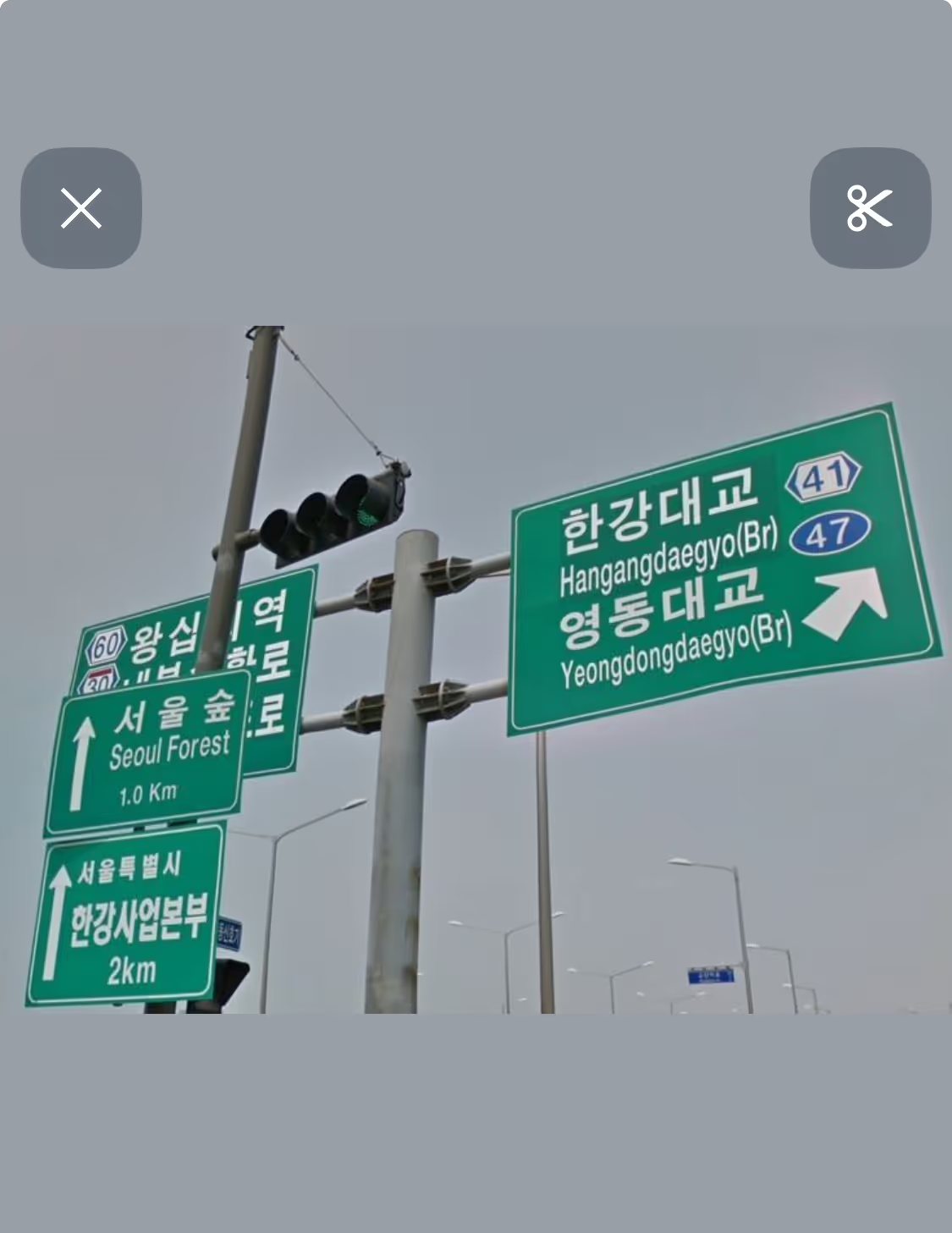
- Signs and directions are in Korean + English.
Use airport pickup if:
- This is your first time in Korea.
- You arrive with family or large luggage.
- You want the simplest option.
1.2 City branches
Popular areas:
- Seoul (Gangnam, City Hall, Yeouido, etc.)
- Busan, Daegu, Gwangju and other big cities
Good points:
- Often 10–20% cheaper than airport rentals.
- Good if you stay in the city first andrent a car only for a few days later.
Weak points:
- English support can be weaker than at airports.
- You must travel to the branch by subway, bus, or taxi.
Use city pickup if:
- You are comfortable with public transport in Korea.
- You want to save money on rental days.
2. At the Rental Counter: Step by Step
Here is what usually happens at the counter.
You can keep this as a simple checklist.
Step 1 – Show your documents
Hand over:
- Your home-country driver’s license
- Your IDP (International Driving Permit)
- Your passport
- Your credit card (in your name)
Step 2 – Staff checks your details
The staff will:
- Check that your name matches on all documents
- Check that your license and IDP are valid
- Check that your entry stamp is within 1 year
- Check that you meet the age and experience rules
Step 3 – Confirm car and insurance
The staff will show:
- Your car type (model or similar)
- Your insurance level (basic, full CDW, extras)
- Any extra options (child seat, extra driver, etc.)
If something is different from your booking,
ask them to explain why.
Step 4 – Credit card deposit hold
The company will:
- Place a deposit hold on your card(often ₩300,000–₩1,000,000).
- The money is blocked, not taken,and is released after you return the car(often 7–14 days, if there is no damage or fine).
Step 5 – Sign the rental agreement
Before you sign, check:
- Pickup and return dates and times
- Location (airport vs city branch)
- Car type and fuel type
- Insurance type and deductible
- Fuel policy (usually full‑to‑full)
If you do not understand a word,
ask staff to write it in simple English,
or use a translation app.
Step 6 – Get your keys and car location
The staff will:
- Give you the keys (or key card)
- Explain where the car is parked
- Sometimes walk you to the car,sometimes give you a parking spot number
3. Language Tips at the Counter
Even at airports, staff English may be basic.
These tips can help:
3.1 Show, do not only speak
- Show your booking email or app screen.
- Point to your name, dates, and car type.
- Have your documents ready in one place.
3.2 Use simple English sentences
You can show these sentences on your phone:
- “Can you confirm my booking details?”
- “What insurance is included in this price?”
- “What is my deductible if there is damage?”
- “Are there any extra fees I must pay?”
- “Can you write the total amount here?”
Keep sentences short and clear.
Speak slowly and avoid slang.
3.3 Use translation apps
If you feel stuck:
- Use Papago (very good for Korean)or Google Translate.
- Ask the staff to type in Korean,then show the English translation.
If, after translation, you still do not understand:
- Do not sign yet.
- Ask them to explain again, or choose a simpler option.
4. Before You Drive: Car Inspection Checklist
Spend 5–10 minutes checking the car before you leave.
Take your time.
This can save you a lot of money later.
4.1 Exterior (outside)
- Walk around the car slowly.
- Look for scratches, dents, cracks.
- Check front, back, left, right, and roof.
- Take photos of all sides.
- Take close‑up photos of any damage you see.
If the staff is with you,
show them the damage and make sure they note it.
4.2 Interior (inside)
- Check seats, dashboard, and doors.
- Test seat belts for all seats.
- Check air conditioning and heater.
- Test windows, mirrors, and door locks.
- Make sure the lights and wipers work.
4.3 Fuel
- Look at the fuel gauge.
- It should be full if the policy is full‑to‑full.
- Take a photo of the fuel gauge.
If the tank is not full,
tell the staff before you leave.
4.4 Hi‑Pass device
Most cars in Korea have a Hi‑Pass device
(a small box near the windshield).
- Check that it is installed.
- Ask how tolls will be charged(usually to your credit card after return).
4.5 Emergency equipment
Korean law requires:
- Warning triangle
- Fire extinguisher
- Often a spare tire and jack(or a repair kit in some cars)
Ask the staff where these are,
so you know in case of an emergency.
4.6 Short test drive
If possible:
- Drive slowly in the parking lot.
- Test the brakes.
- Check steering and any warning lights.
- Listen for strange sounds.
If something feels wrong,
go back to the counter immediately
and ask for a different car.
5. Fuel Policy and Tolls (Hi‑Pass)
5.1 Fuel policy (usually full‑to‑full)
Most rentals in Korea use full‑to‑full:
- You pick up the car with a full tank.
- You must return it with a full tank.
If you return with less fuel:
- The company will add a refueling fee(often ₩30,000–₩50,000),plus the fuel cost.
To avoid this:
- Fill up at a gas station near the branchbefore you return the car.
- Major brands: GS Caltex, SK Energy, S‑Oil, Hyundai Oilbank.
- Keep the receipt until after return.
5.2 Tolls and Hi‑Pass
On most highways in Korea:
- You do not pay with cash.
- Tolls are charged through Hi‑Pass.
How it works:
- Your car has a Hi‑Pass device on the windshield.
- You drive through lanes with blue Hi‑Pass signs.
- Tolls are recorded and latercharged to your credit card or added to your bill.
Example tolls (one way):
- Seoul → Busan: about ₩30,000–₩40,000
- Seoul → Gangneung: about ₩15,000–₩20,000
- Incheon Airport → Seoul: about ₩5,000–₩8,000
Jeju Island:
There are no toll roads.
You do not pay highway tolls there.
6. Returning the Car
6.1 Before you return
- Refuel to a full tank (take a photo and keep the receipt).
- Remove trash and personal items.
- Check the glove box, trunk, and under seats.
- Take photos of:
- Exterior (all sides)
- Fuel gauge
- Odometer (distance)
These photos are useful
if there is a later question about damage or fuel.
6.2 At the return location
- Park in the return area (follow “Rent-a-car Return” signs).
- Wait for staff to inspect the car.
- Give back the keys and any devices (Hi‑Pass, GPS).
- Ask for a return receipt or confirmation.
6.3 Late return
Every company has its own late fee rules,
but common patterns are:
- Grace period: about 1 hour (no extra charge)
- 1–2 hours late: small fee (around ₩10,000–₩20,000)
- 2–6 hours late: larger fee (around ₩30,000–₩50,000)
- Over 6 hours late: often charged as one extra day
If you know you will be late:
- Call the company before the return time.
- Extending your rental is usually cheaperthan paying late fees.
7. Pickup and Return Checklist
You can use this as a quick checklist on the day.
At the counter
- [ ] Show license, IDP, passport, credit card
- [ ] Confirm car type and insurance
- [ ] Check total price and deposit hold
- [ ] Check dates, times, and locations
- [ ] Sign only if you understand the main points
At the car (before driving)
- [ ] Take photos of outside and inside
- [ ] Check fuel level and take a photo
- [ ] Find Hi‑Pass device and emergency tools
- [ ] Do a short test drive in the parking area
- [ ] Go back to the counter if anything is wrong
Before return
- [ ] Fill fuel to full (near the branch)
- [ ] Remove trash and personal items
- [ ] Take photos (fuel gauge, odometer, exterior)
At return
- [ ] Park in the correct return area
- [ ] Wait for inspection
- [ ] Return keys and devices
- [ ] Get return confirmation
Important note about updates
Rental processes, fees, and policies can change at any time.
This article was written in February 2026.
Before you travel:
- Check the latest rules on your rental company’s website.
- If something feels unclear,ask the staff in English or use a trusted travel agency.